Maliki Poison of the Past:
combat system

Credits:
Developed by Blue Banshee Games
Creative director: Maliki
CEO: Etienne Jacquemain
Producer: Maël Guérin
Game designers: Clément Gastaldo, Aurélien Lubecki
Introduction - defining game pillars
As the targeted audience for the game was quite heterogenous, I had to design a system that would convince occasional players (including Maliki’s fans, and amateurs of cozy games) as well as turn-based RPG addicts. Throughout the development, we focused more on the latter than the former, as I was asked to propose something original, innovative, and a bit challenging.
When I have started working on the project, I suggested we lean on two main game pillars, that summed up in my opinion the philosophy of the game:
The first pillar of the game is “Temporal adventure”. Story, gameplay, levels… Everything is related to the joy of exploring different eras, while expecting twists and mechanics related to time. The team travels using time portals, to confront the antagonist at different eras in the past. Moreover, the main character Sand uses the chronopack, an object/weapon able to manipulate time.
The second pillar would be “Taking care / Creating bonds”. A small party, building connections, messages related to Nature and mankind, a farming system… The project goes beyond the “power of friendship” trope to embrace care, (chosen) family and relationships in a broader way. The main character doesn’t know anyone, but all other characters have strong relationships, sometimes buried under amnesia.
PILLAR I
TEMPORAL ADVENTURE
PILLAR II
CARE / CREATE BONDS
Must be very different from each other, and distinct in frozen VS unfrozen time.
Time is shattered.
The world is made of places disconnected spatially and temporally.
Time travel, temporal loops...
How time heals and hurts
Investigation and mystery
Quests spread through eras. The player also takes advatange the NPCs are frozen in time.
Time manipulation will be one of the powers used in puzzles.
Key feature of the combat system will be related to time manipulation.
Better control and understanding of time
Themes
World / setting
Levels
Quests
Puzzles
Combat
Progression
Meaning of family
How we easily drift apart
How relationships need care
The centre of the world is the Domain, where lives a "family", even if they are not connected by blood.
Family hub plays an important role as an inter-level zone
Some quests make party members closer. Quests address a lot of care- and family-related themes.
All party members' powers are used for puzzle solving.
The party is limited to four characters and their bonds must play a role in combat.
Solidarity (re)connects the party members
PILLAR I
TEMPORAL ADVENTURE
PILLAR II
CARE / CREATE BONDS
I’ve been working on analysing the expectations and hurdles around turn-based RPG development, and came up to the following conclusions about what the combat system should and could be:
Quick and responsive: one of the complaints about (old?) turn-based games is the presence of waiting times or long and ugly list of skills. Menus must be responsive and simple, animations must be fast and clear (or skippable). This aspect must also be kept in mind when designing menus outside of combat (equipment, character management, etc…).
Action: the player must “feel” the battle action despite playing a turn-based game. Some turn-based games choose to incorporate real-time action elements such as QTE, others just rely on overall dynamism (pace, camera angles, VFX…).
Novelty and diversity: turn-based RPGs are often accused of being repetitive. In fact, redundancy is a trait shared with other genres, but it weighs more in this one, while the player often switches from exploration/story to combat screens. Thus, the game must find ways to keep the player entertained from a combat to another, using the following elements:
-
Bestiary diversity: large panel of enemy types, with different abilities
-
Entertaining boss fights: offering diversity (strategic and artistic) and challenge
-
A sense of progression: new mechanics, feeling of power growing
-
Rewarding fights: understanding and exploring the system should bring satisfaction !
-
Last but not least… A key original feature ! The game design should mix innovation with reliable genre landmarks to be appealing.
How to make a good turn-based system nowadays?
Octopath Traveler (Square Enix, 2018) assumes its old-school roots with its visual design and its system, and at the same time, lights up the turn-based formula with a deep but easy-to-learn system, a simple and efficient UI, and very satisfying VFX.

Persona 5 (Atlus, 2016) is widely known for its unique artistic direction, which includes a strong and instantly recognizable UI. Combined with excellent UX and smooth camera work, its combat system sets a benchmark for how turn-based gameplay can truly ooze "action" without relying on real-time mechanics.

My first choices to shape the system
No (or minor) action elements
A small party
Standard system basics
Time-related key feature
Strategic creativity
After this analysis and taking into accounts the game pillars and specifications, I came up to the following choices:
As an aficionado of pure turn-based combat, I wanted to bet on an engaging system not leaning on strong action features. Persona 5 was my main reference on this aspect: aesthetics, pace and ergonomy are doing enough to diffuse this sense of action. That’s why I also wanted an effective UI with quick access to combat options.
A cohesive cast of 4 playable characters, and no one on the bench ! I was also thinking about common resources in combat (gauge, shared aptitudes, experience…) and synergies (combos, complementarity…), to reinforce the “taking care / creating bonds” pillar.
I would rely on standard stats (HP, mana, strength, defense, “magic”, “magical defense”...) and light equipment management (one or two pieces per character). As the team is small, I also wanted a high potential of customisation, with no predetermined classes, only tendencies, allowing the player to orient each character differently, using combat techniques and equipment.
The key feature will be related to time manipulation: that sounded obvious ! I thought about playing with the order of turns, inspired by existing systems (“press turn” for the Shin Megami Tensei / Persona series, “turn economy” for Bravely Default / Octopath Traveler). I was also thinking of time as a resource, or justify turn-based combat with time-related reasons…
The key feature should allow creativity and appropriation: as our target was not an RPG expert community, I thought about designing a feature enhancing your strategic capacity in combat, but not leading to “gimmick” fights (“I must find the only way to tackle this fight”).
Designing the key innovative feature
While thinking and drawing timelines mimicking turn order management, and initially inspired by the system of Final Fantasy X's system (“weight” of an actor’s action delays their next turn), I came up with this idea of these “scissor movements” for the timeline. Some actors have their portraits on top of the timeline, others below it. If the player moves the upper part to the left, the lower part goes to the right, and vice-versa.
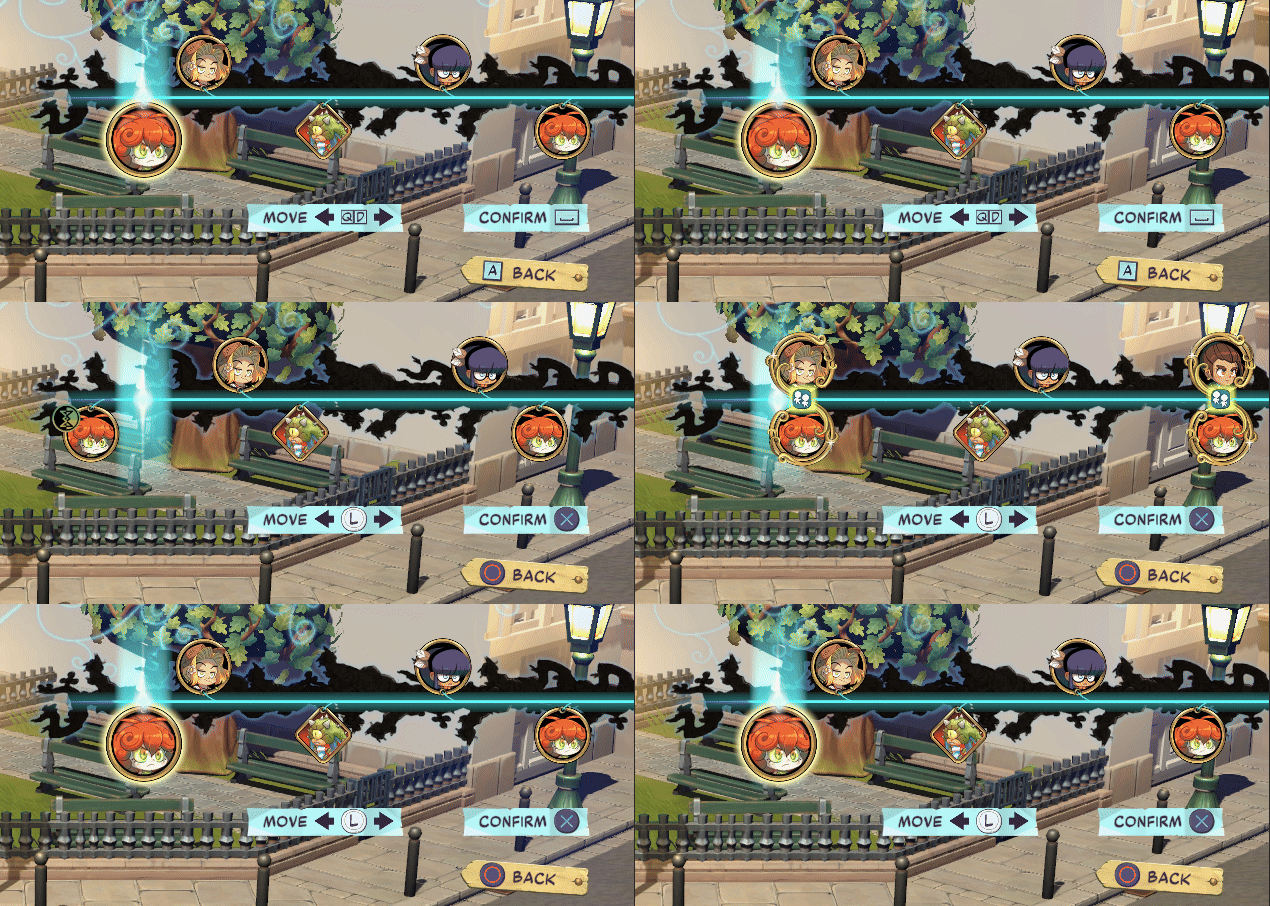
With this manipulation, the player can change the turn order, creating specific turns with two characters, two enemies, or one character with one enemy. Once they understand the way it works, they can try and test different combinations depending on the situation.
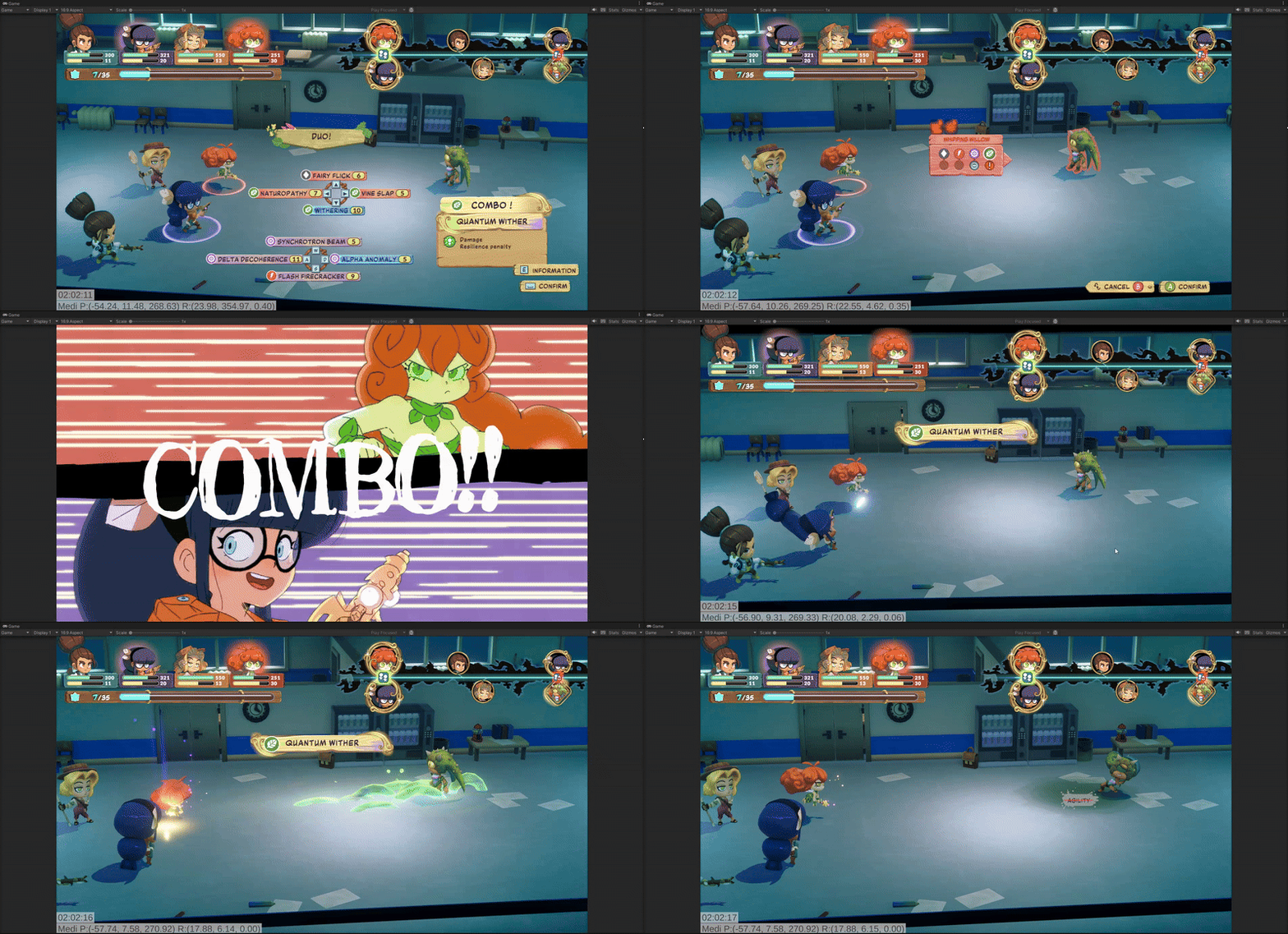
Two characters together: offers combo opportunity. Each duo of characters has at least two original combos. I made the controversial choice to limit their combat options to techs. It means that if your character is low on TP, they cannot play during this turn. Consequently, it requires anticipation !
Two enemies together: could be either a bad move (two enemies comboing together), but also an enemy neutralization in some cases (example: two big enemies collide with each other while trying to attack). Unfortunately, for schedule reasons, this last aspect has not been developed, and only one boss combo in the game is interesting for the player.
One character / one enemy together: I drew inspiration from Baten Kaitos’ combat system, in which during the enemy phase, the player can use actions to protect themselves. Here, the player can either use the “Guard” command, or a “defensive version” of one of the character’s techniques. For this special configuration, I wanted to create a turn where the player is “invited” into an enemy turn; so the enemy is playing no matter what, and the player has a short amount of time to play a defensive action.
Combo resulting from two character turns being ovelapped.
A character uses a "defensive version" of a skill, as her turn is ovelapped with an enemy turn
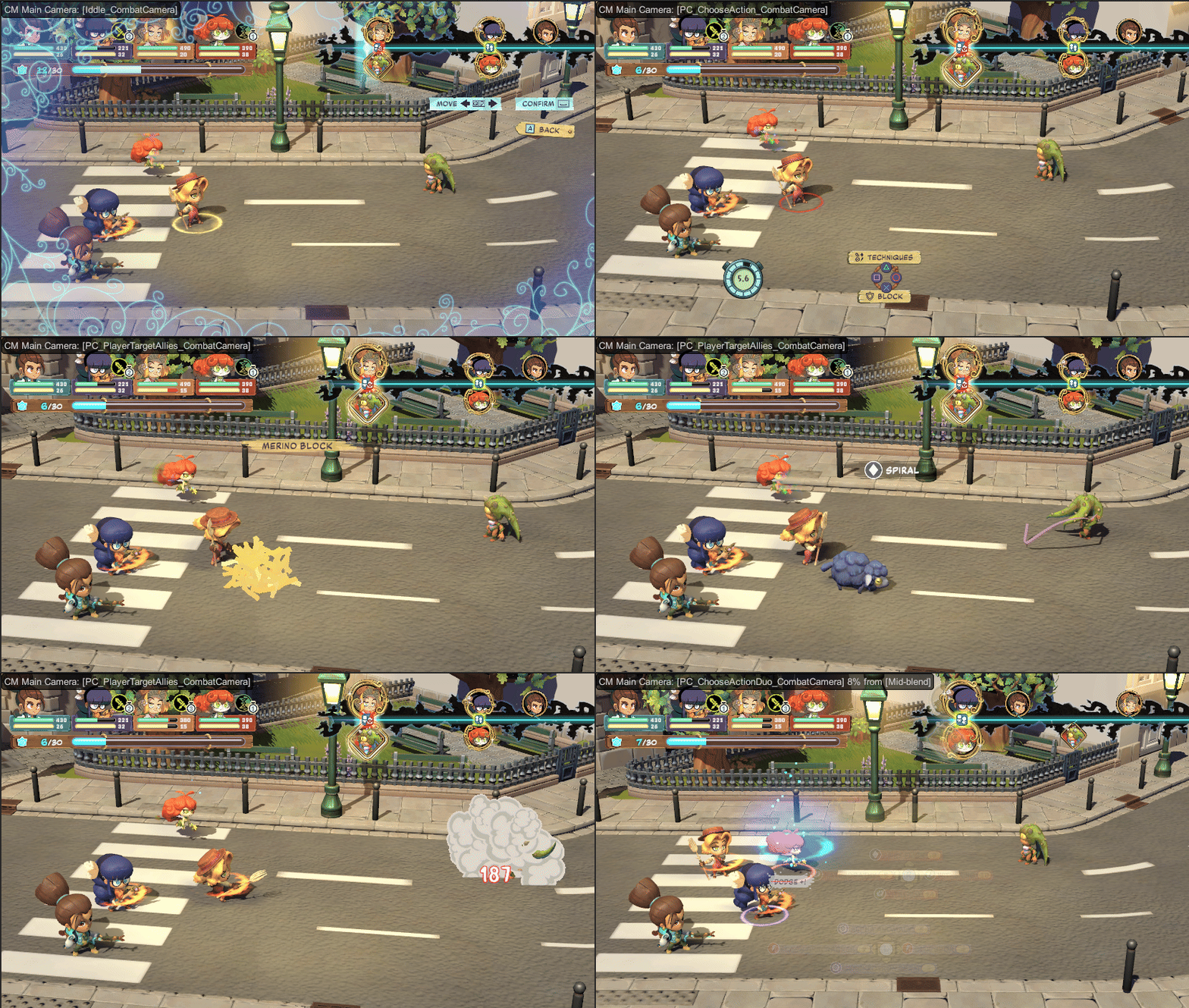
Baiting the player with healing capacity
This scissor movement has been called a “temporal slide”. My take was to encourage the exploration of this without forcing its use too much.
This mechanic creates a specific timeline position that I called “paradox”, where the current character is moved “before the present time”, which is equivalent to a turn being skipped. I made this the main healing capacity (HP AND mana !) so the player uses it frequently, consequently altering the timeline, making them explore duo/duel turns!
healing
HP and mana
"paradox"
position
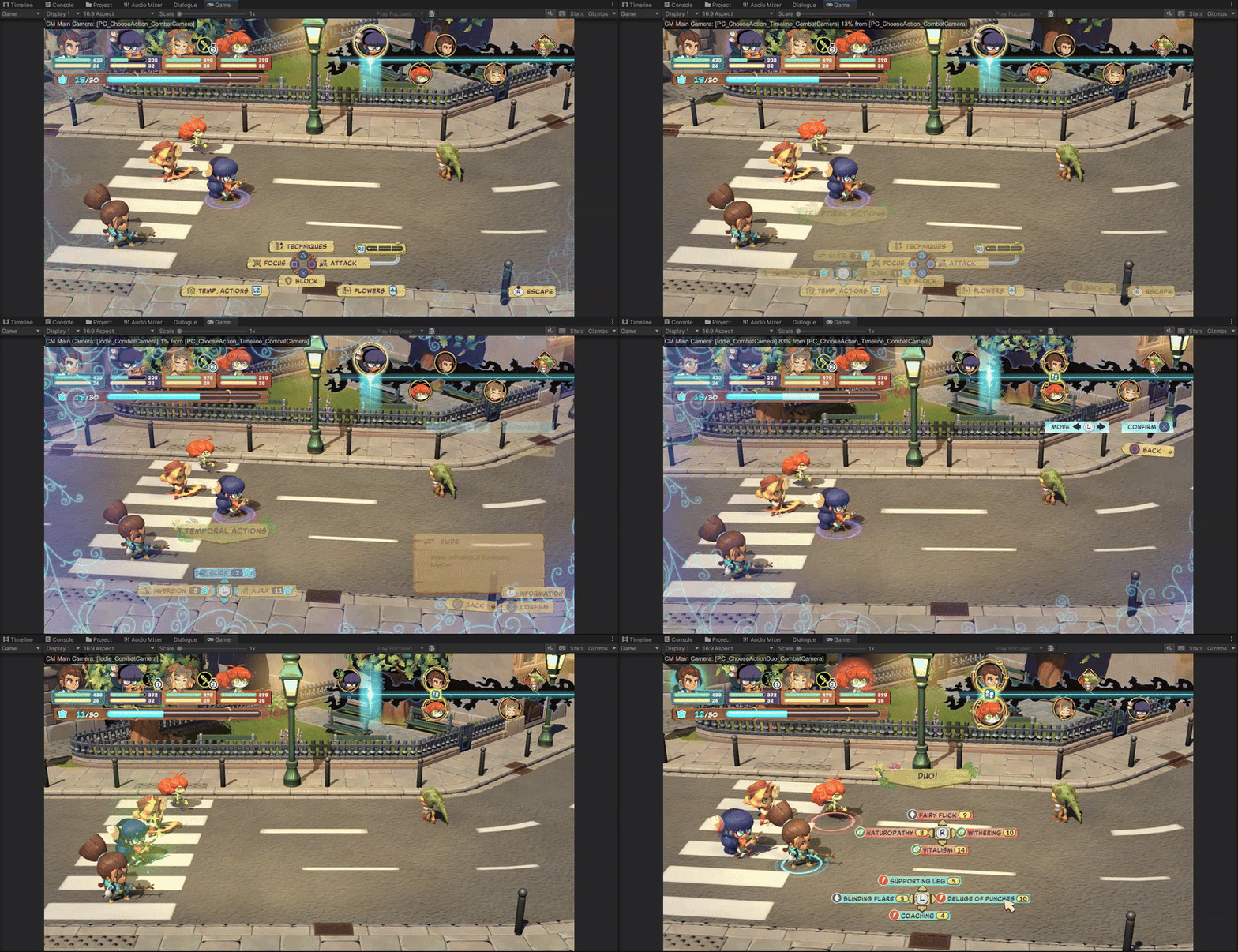
Trying to bring subtlety - other temporal actions
The temporal slide is really the central time manipulation action. It can be improved twice in the game, giving the capacity to perform 2, then 3, slide iterations in one action.
I needed other temporal actions to spice up the formula and I came up with the following:
-
Temporal inversion: the player moves an actor from one side of the timeline to the other. It seems like a very subtle and light feature, but it is strongly useful if the player wants to control the timeline:
-
It can be used to stop two enemies from comboing together, which makes several endgame fights easier.
-
Used before slide, it can allow a duo or duel turn by putting two actors on both sides on the timeline.
-
I made its cost very low as it is quite situational.
-
-
Temporal aura: the target actor will play twice in a row. This sounds very expected, but this feature actually hides another one… If the player has the curiosity to make a character play with themselves, they will discover the superturn / resonance turn, during which the character has very high offensive and defensive temporary bonuses.
System attrition
Every character can perform a single temporal action at the beginning of their solo turns. For this, they need a number of “chronopoints” (CP), drawn from a group gauge. Each character can use a command called “Concentration” to fill this gauge. This system, involving characters concentrating to fill a common meter, was heavily inspired by the focus system from Skies of Arcadia.

Chronopoint gauge
“Counter-mechanic”: chronopoint injection
I was asked to place a lot of encounters on the map, so I had the constraint of having a lot of short battles: that is why the temporal action feature, which is related to taking one’s time to plan a strategy, was more appropriate for unique enemy / boss fights. Confronting mobs, only the need to heal really demands a use of temporal slide.
In spite of this, I wanted this key resource (chronopoints) to have a second and more direct use. In addition, I wanted to tackle a recurrent problem in turn-based RPGs: the spamming of the “Attack” command for mob fights, often happening during fights the player wants to end quickly instead of really playing. I had to expect this problem for our game, with the important number of fights it contains.
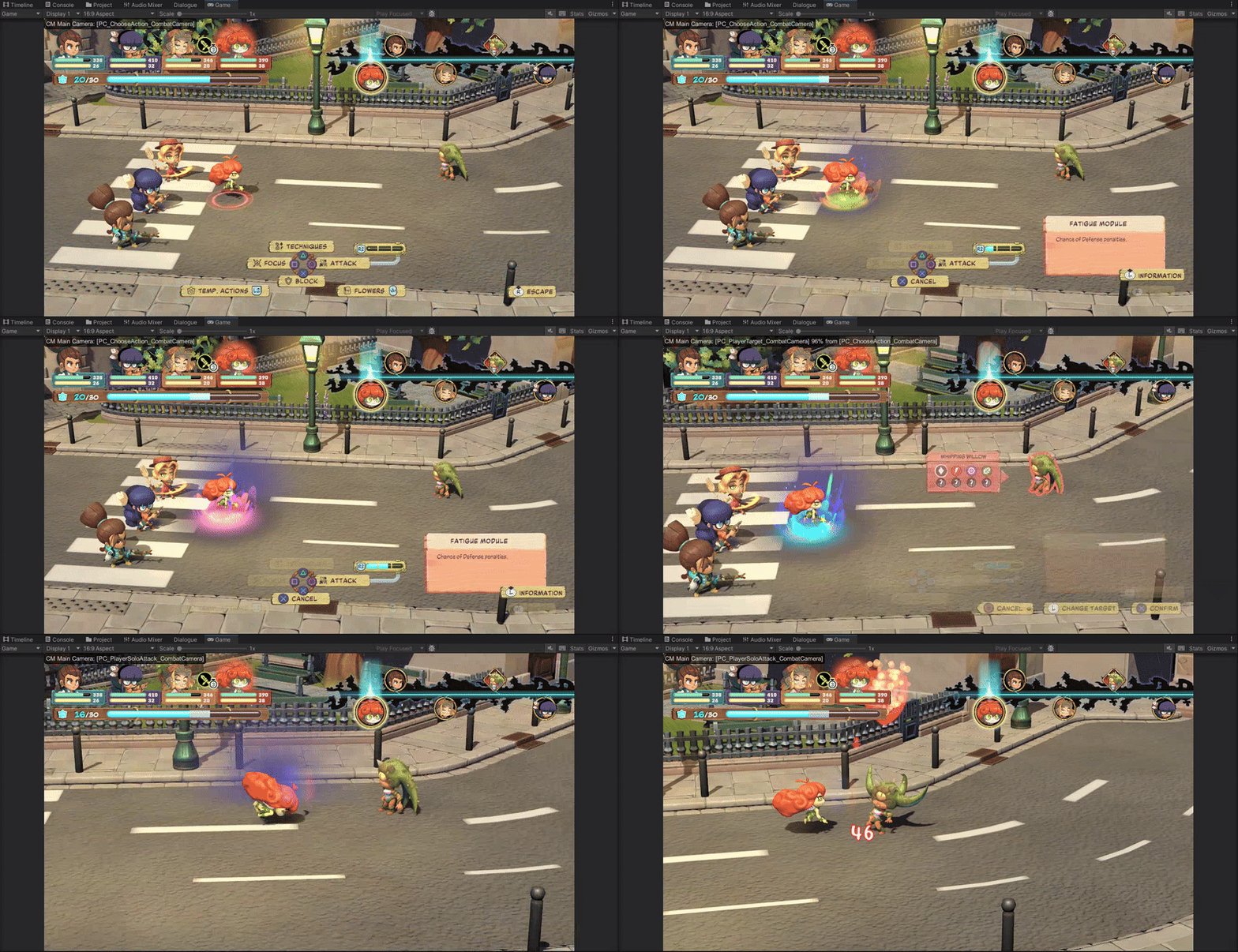
Therefore, I solved both issues by giving the possibility to “inject” CPs in the Attack command. The player chooses between 3 amounts before launching the Attack: it will increase its power and will have a special effect, scaled in probability or efficiency on the injected amount. This feature is partially inspired by gameplay elements of Octopath Traveler and Sea of Stars, while still leaning on the same common resource management of Skies of Arcadia.
What I call a “counter-mechanic” is a second mechanic using the same resource, but used only as a clever alternative if the first one is tedious or not adapted to the situation. So if the player does not want or need to use temporal actions and associated planification during regular fights, they can quickly use the CPs cumulated in the fight to enhance the Attack command of their characters, opening the way to a crafting/equipment system of “weapon modules”. Balancing the CP injection was of course crucial, otherwise this simple and less original feature would have been able to replace the key innovation of the system !
A character injects chronopoints in her attack, enhancing damage and granting defence debuff capacity.
XP and stats, techs and elements
Having designed the core original features, I tackled the rest of the system, following the choices and guidelines already set. I really wanted “straight-to-the-point” elements to compensate for the potential complexity of time manipulation.
I liked the idea of a common xp meter for the whole team, as a lean and transparent progression was, to me, more suitable for a short game (besides, I have always questioned the real interest of individual xp when the party is small…). At each level threshold, predefined stat gains are given to each character: no need to reroll nor complain about RNG.
I added to the xp progression the unlock of most of the game’s techniques, removing the need for a subsystem dedicated to this. However, sidequests can give the players new combos !
The techniques are associated to elements; a classic fire/wind/water/etc system would not have worked within the game’s universe, so discussing with the comics’ author, I came with this proposition of 3+1 elements:
-
Normal: neutral element, the one used by regular attacks and some techniques.
-
Kinetic: associated with speed, weight, and movement. Specialty of Sand, the main character.
-
Techno: associated with technology, quantum physics, electricity. Specialty of Fang.
-
Nature: mostly associated with vegetal and magic power. Specialty of Fenimale.
The system does not contain an official rock/paper/scissor triad, as enemies do not have a “type”. Instead, similarly to the Persona series, the player will test for each new enemy their weaknesses and resistances, sometimes being hinted by their aspect:
-
Machine-like and techno-based enemies are often “disrupted” by Kinetic techniques.
-
Animal and vegetal enemies can be vulnerable to Techno.
-
Less obviously, fast/physical foes are often overcome by Nature power.
I added a few status effects (Stun, Toxine, Impairment and Silence), working quite commonly, so I will not detail them here.

Leveling screen, with stat gain indications
Equipment - simplicity and customization
I wanted very light equipment management but interesting strategic possibilities arising from it.
Offensive equipment - modules: we already presented the weapon modules, associated to chronopoint injection. Each one can be equipped by one or two characters, and they provide an effect on the Attack command, as well as extra damage. Here are some examples:

Defensive equipment - accessories: each character can equip a specific type of accessory (shoes for Sand, glasses for Fang, hats for Becky, and bracelets for Fenimale). I wanted to gather a lot of strategic aspects within the accessories, including:
-
Various Defense / Resilience bonus, the only thing that can get improved with the accessory upgrade
-
Up to 2 positive effects, and up to 2 negative effects: they can include elemental resistances/weaknesses, HP regeneration, Guard improvement, status effect immunity, etc…
A lot of these accessories have been thought to mimic RPG archetypes/playstyles, for simple but efficient character customization. Here are some examples:

-
Lumberjack boots (tanky and precise profile): useful boots found in the very first level. Sand earns a very high defense bonus, and a useful resistance to all normal attacks. A precision bonus counterbalances the frequent precision debuffs caused by early-game enemies.
-
Old lady’s glass ("vampire ninja"): quite low defensive bonuses, but Fang is now able to dodge attacks and regain HP when she deals damage.
-
Avant-garde hat (“chrono-knight”): Becky benefits more from the game key feature with more CP earned when she uses Concentration AND she deals extra damage during duo turns. These skills are found in accessories for other characters, as I really wanted to reward the players using temporal actions and combos !
-
Simple rings (healer): Fenimale is an hybrid mage/healer profile, and this accessory enhances her healer side: extra HP healed, an improved Guard (against Special damage), but in exchange she loses a bit of her Nature power, dealing less damage.
Very often in turn-based RPGs, equipment comes and goes in the player’s inventory, sometimes giving them no time to really exploit a specific weapon or armor. Here I wanted every accessory to be relevant till the end of the game, at least for certain fights. That is why each of them can be leveled up to level 5 to increase its stats bonuses and avoid being obsolete.
Accessory menu

Interface with other systems
When I started working on the combat system, the game already had a farming system allowing the player to cultivate crops in the Domaine (hub), and cooking/crafting systems were required as well but not yet designed.
I had to take into account that farming was “not necessary, but rewarding”. Farming gives the player access to new zones, to expand the Domain, finding new ingredients and having more space to cultivate more efficiently. Moreover, the Tree offers more and more chronotons, a special component I included in the crafting of rare accessories.
I created two straight-to-the-point systems:
-
Crafting: in theory, no need to grind a lot of things, except if the player wants to craft everything. Chronotons are required for rare and powerful accessories: even if the player does not farm, some of them will be found after boss fights or sidequests. For weapon modules, specific materials called folioliths are needed, looted by rare unique enemies.
-
Cooking: dishes provide a 20 min effect, affecting either combat stats (a single stat is boosted), loot after combat, chances of escape, xp bonus… Therefore, I came up with the following typology for player profiles, with associated advantages:
Evaluation of experience vs player profile
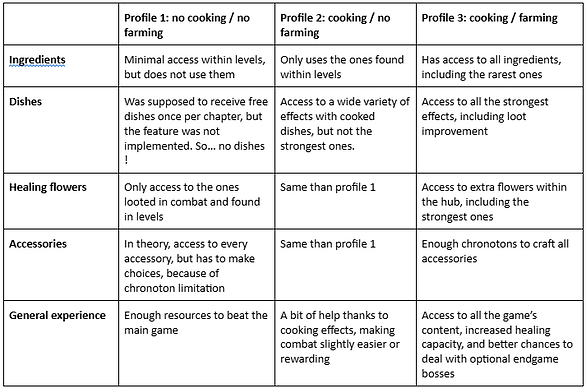
I encompassed everything into an economy system, summed up with this diagram:
Diagram - game economy

System analysis - postmortem
I would like to take a time to reflect and look at the flaws in this combat system. What would I change if I had to design it all over again?
Because of operational hurdles and financial priorities, no prototype nor playtests (even within the team) have been done for this combat system. In that regard, I am quite happy it received decent feedback from the players and game press anyway! Still, the system does not work as I expected and it is now time to investigate this!
The main flaw of the system is it is not forcing the player to master it. This “player do what they want with these creative tools” approach that I took made a lot of players relying mostly on the basic functions that any RPG would have (attacking with powerful AOEs, not using duo turns).
Even by baiting them to heal with Paradox, I noticed that not a lot of players explore deep timeline manipulation.
The following suggestions would improve this aspect:
-
A sub-system demanding the use of combos or defensive version: this could materialise with special effects to destroy shields on some bosses, requiring combos for example. This would demand to rethink a bit the formula behind timeline management, making it more predictable, or add other capacities to handle the timeline (the power to diminish the distance between two actors, perhaps? or switch two characters wherever they are on the timeline?).
-
More feedback for the combos: indicating what combos are available when two characters perform a duo turn was a feature we were supposed to implement, but was finally cut for budget reasons. Stronger VFX or UI elements could also have been used to draw attention to the power of the combos and defensive techs.
-
Making the whole thing very dynamic and smooth: make timeline manipulation more natural, faster, so that the player also wants to also use it against mobs and limit it to bosses.
This taught me an important lesson, one I actually already knew but that I did not keep in mind while designing: players will “always” go to the simplest. If the complex features of my system are more of a polite proposition, and that at the same time I give them all they need to play in a more simple and straightforward way, they will have a tendancy to choose the latter.
Besides this main hurdle, I noticed the following elements that would require changes:
-
Limitation to 4 techs per character: originally thought to match the 4 directions for controls, and to force players to make choices, as each character posesses 8 techs. 5 would have been an ideal number instead, allowing more exploration and less changes in menus (and also less one-tricked routines)!
-
Invisible enemy HPs: I confirm I do like this approach if an approximative feedback is given to the player about remaining enemy HPs. I took inspiration from Dragon Quest XI: the name of the enemy appears red when HPs are below 25%. The problem is that most players don’t notice it, and Dragon Quest XI had another (higher) threshold with the name displayed in yellow. This second threshold would have been really useful, as a lot of players complained about this.
-
Limited time for dual turns and hype them up a bit: it’s the only “action” element in the system, inspired by Baten Kaitos. It made sense lore-wise: as the player and enemy are in the same turn, the enemy does not wait. But it does not really add up to the rest, and it really does not encourage the player to use these dual turns more often! I would remove this, and as we say before, bring more feedback to these defensive techniques. Shiny and cool visual effects carve themselves into players’ mind, more than a slightly higher damage number or a not-so-obvious strategic advantage.
-
Consequences of the common xp gauge: a simple consequence is that the player is not required to keep all their characters alive if a strategy based on a sole character survival allows them to win, whereas separate xp management punishes you in that regard. To keep the qualities I liked about common xp, I would maybe have linked the amount of xp gained to the number of surviving characters.
-
Talking about XP, the gained stats while reaching the next level are a bit high, really making the difference against a boss. This is not what I wanted in a game that really tries to avoid grinding! The two solutions would have been to either smoothen the stat improvements, or to either adapt the bosses to the player’s level and inform the player about it.
