Carboniferous
Credits:
Prototype developed by Blue Banshee Games
Creative director: Maliki
CEO: Etienne Jacquemain
Game designer: Clément Gastaldo
Project overview
Following a temporal cataclysm caused by Maliki, the fauna and flora of the Carboniferous era have flooded into our world, accompanied by a significant rise in water levels. The player takes on the role of Maliki, seeking to repair her mistake and send these creatures back to their original time.
The initial creative vision revolves around rescuing both modern and prehistoric animals in a submerged world, drawing inspiration from Ponyo by Hayao Miyazaki.
Ponyo (2008), directed by H. Miyazaki, shows the colorful seaside setting flooded by the sea, with the appearance of Carboniferous creatures.

The project quickly evolved toward a gameplay-first approach, allowing me to establish a clear and well-argued gameplay vision. We aimed to deliver a focused, engaging, and humorous experience—one that delivers memorable and “streamable” moments.
The vision is concretised into the following guidelines:
-
The core gameplay revolves around player interaction with an unusual Carboniferous wildlife. This interaction is cristallised into unique player-dependent gameplay moments, carrying the true value of the experience.
-
The game relies on rich systems that encourage this emergent gameplay: animal routines, inter-species interactions, diversity of reactions to player actions, interactive environment...
-
The player engages with animals through observation, analysis, and strategy, rather than violence (while animals may interact aggressively with each other)
-
No fail state or player death—only the frustration of seeing a creature escape
-
The player’s objective is to "collect" animals by guiding them into vortices; once the required creatures are gathered, new paths unlock or world events are triggered (climate shifts, flooding, etc.)
-
The world blends flooded human settlements with lush Carboniferous vegetation
-
Progression is non-linear, driven by player captures, with light puzzle-solving elements unlocking new routes
Systems and creatures
To go on with this systemic approach, we have to consider the sources of gameplay as three macrosystems:
Player actions
No superpowers, only simple actions putting emphasis on interaction:
- interactions with environment or animals: carry / throw / set free
- interactions with animals: bait / feed / pet
- stealth skills: crawling, hide...
Animals
Wildlife is an autonomous macrosystem, independent from the player's actions:
- mechanics of fear and interest
- senses: sight, hearing, smell
- ability to seek safety / to hide
- each type has its own routine / behaviours
- interactions between species: fear, agressivity, predation...
- interactions with environment: swimming, eating grass, climbing...
Environment
Mixing post-flood modern world with Carboniferous flora, the environment plays a great role in the gameplay:
- diversity of terrains (verticality, flooded areas...)
- interactions with animals
- specific properties of zones invaded by Carboniferous flora
- periodicity: day/night? weather? hazards?
The Carboniferous setting of the project provides a strong foundation for imaginative creature design, with the following advantages:
-
These animals are far less present in pop culture than later dinosaurs, enabling a better branding/identification for the project. Besides, there is more room for (re)interpretation of the bestiary, as the audience has less bias and precise expectations about it.
-
Still, this fauna offers a lot of diversity: giant insects/arachnids (centipedes, dragonflies, spiders...), amphibians, fishes... giving a lot of gameplay opportunities.
Following our "gameplay first" methodology, I started to create a list of various design archetypes, that could be later associated to Carboniferous-inspired creatures. Here is a non-exhaustive list:
-
The perfect prey. Cute, easily follows the player, but has so many predators. Source of a lot of "funny" moments when it gets eaten.
-
The pollen lover. Fearful, but totally vulnerable near a pollen source, making it approachable by the player, but also its predators.
-
The bull-like creature. Charges the player like a bull. If it is correctly dodged, can be stuck into a wall and allow the player to access upper areas!
-
The smelly one. Easily follows the player, but makes most creatures run away!
-
The grass eater. Eats specific plants, unveiling new passages for the player and other animals.
-
The rare one. The player should often see mysterious traces of it, but it is hard to find and catch it.
Artistic view of Arthropleura, a 2.6 meter arthropod.

Designing the prototype
The company needed to create a convincing prototype to look out for fundings. Our dev team was busy with the release of Maliki - Poison of the Past, so we had to externalise the development part for this 1-month prototype. My missions were the following:
-
Define the scope of the prototype
-
Design 3C and creature AI
-
Define guidelines for level design
-
Test and balance systems
-
Manage QA and user experience aspects
-
General project management with the external team
I defined the following scope for the prototype project:
-
A free non-guided experience, where the player discovers the animals, interacts with them, and finds out about objectives while exploring.
-
Objective: a certain number of each type of creatures has to be brought to a blue hole.
-
3 animals giving a glimpse of game interactions:
-
Creature 1 is small and fearful, the player can bait it with a twig and carry it. It is preyed by the two other creatures.
-
Creature 1 alpha is a slightly bigger and colorful variant of creature A. If carried by the player, the other creatures A follow them.
-
Creature 2 is hungry for creatures A. In addition, when it is eating, the player can jump on its back to reach upper zones.
-
Creature 3 cannot be "collected" and plays the role of an environmental danger for creatures A.
-
Extract of the prototype pitch deck, showing use of Creature 2's bumper property.

Extract of a design table, listing all AI behaviors

-
I also wanted the character's moveset very simple and easily understandable via the HUD. Maliki carn crouch, grab/drop a twig and play with it, carry small creatures, jump, and shout.

In-game HUD
Level design and progression
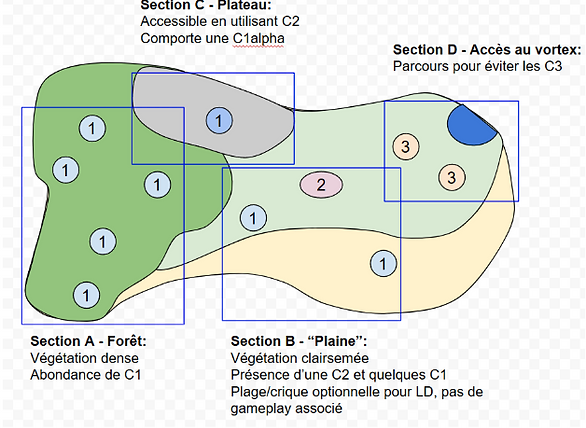
I did not design the level in detailed and only gave general guidelines and circulation indication. We wanted a biome showing the twisted diversity of environments (beach, meadow, Carboniferous jungle...). The following drawing was one of the documents setting the basis of our discussion with art team:
-
Section A is a Carboniferous forest containing a lot of C1s. Circulation comprises different small paths around big trees.
-
Section B is a very open areas with high grass and few trees, a small beach and some man-made elements. With section A they conveyed the most the artistic influences of the project. It contains the only C2 of the prototype.
-
Section C is an upper area containing the only C1alpha of the prototype, used to attract other C1. It can only be accessed by jumping on a C2 while it is eating.
-
Section D is a forest and the nest of a few C3. The player has to be careful and find the safer paths between C3s, to lead safely the C1s to the blue hole.
As the player goes near the blue hole in section D, the objective is revealed and the required creatures are shown.
Popping UI showing objectives as soon as the player goes near the blue hole.

Still, this pseudo-sandbox approach was not approved/understood by several testers. It actually missed the mark as a prototype whose goal was to convince investors. Therefore, we added in-game several spots displaying text info, and completed our pitchdeck with more explanations about the concept.
Conclusion
Despite several investors receptive to the project and its potential, no funding was found for the project. It was still a very strong experience for me, from the large project definition to the prototype execution; I truly had evolved from a junior game designer to someone able to articulate a complete vision while keeping into account context and market situation, even if it was not enough.
At least our trailer caught a lot of attention and intrigued the gaming/paleo community!
